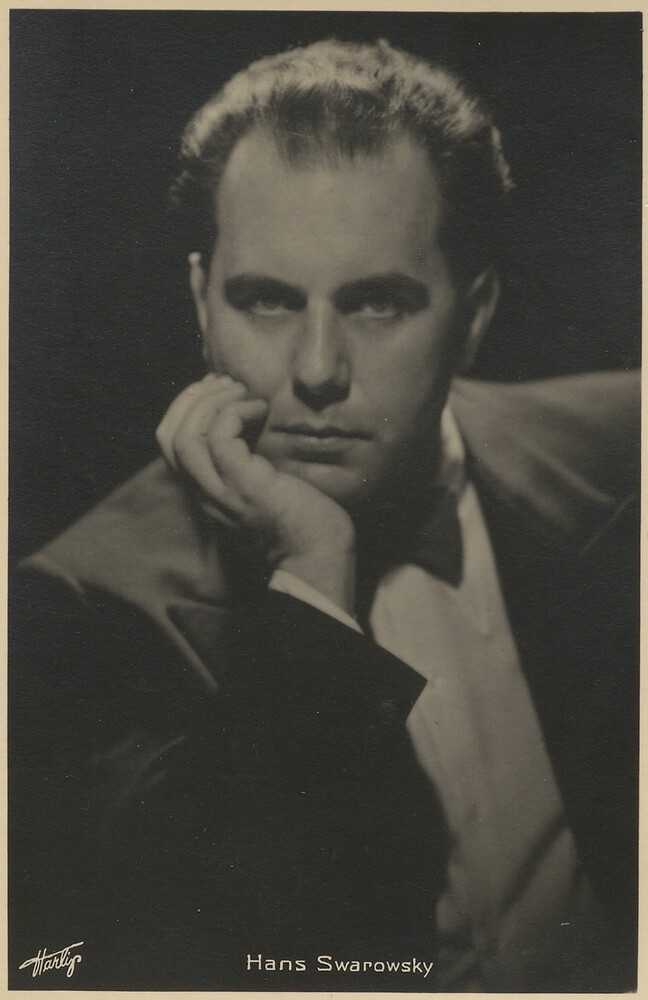
Hans Swarowsky 1899–1975
2019 the mdw purchased the estate of Hans Swarowsky. Other than an expansive catalogue of sheet music, it also contains vinyl records, books, miscellaneous writings, photos and audiotapes. As of late 2022, all roughly 900 musical scores are recorded in the university library’s online catalogue. Since early 2026, the roughly 20 archival boxes of writings have also been catalogued and are available for use. These contain newspaper articles, programme booklets, self-written texts, Taktgruppenanalysen (lit. “bar group analyses), correspondences (among them heretofore unpublished letters from Richard Strauss), translations, and diverse biographical documents.
Childhood and musical education
Hans Swarowsky was born out of wedlock on 16.09.1899 in Budapest. His mother, Leopoldine (1881–1970), was an actress, his father Josef Kranz (1862–1834) was a Jewish industrialist who facilitated Swarowsky’s entry into Vienna’s music scene. He participated in the premiere of Mahler’s 8th Symphony as a choir boy and, starting in 1920, received lessons from Schönberg and later Webern. Traces of both teachers are present in a score of Pelléas et Mélisande: Swarowsky re-inscribed comments and Taktgruppenanalysen by Schönberg and Webern that he had previously noted elsewhere in the 1920s (digital object 11). Initially, funding his lessons was no obstacle due to generous support from Josef Kranz; however, after its discontinuation in late 1922, Swarowsky had to secure his own income and started to work as an accompanist at the Vienna Volksoper under Felix Weingartner.
First conducting experience
He learned conducting from Clemens Krauss and Richard Strauss, among others. In 1925 he received his first position as Kapellmeister (chapel-master) in Vienna. From 1927 on he had diverse appointments as a conductor in Germany. In 1936 he was placed under a conducting ban. In 1938 he received a job as Kapellmeister in Zürich, where he worked until 1940.
1940s
Following that Richard Strauss, with whom he had previously kept regular letter correspondence, helped him to a job at the “Reichsstelle für Musikbearbeitung” in Berlin, where Swarowsky produced translations of libretti. 1943 Swarowsky taught the fundamentals of conducting at a summer course under the guidance of Clemens Krauss (digital object 1). Between autumn of 1944 and spring of 1945, he was chief conductor of the Philharmonics of the Kraków General Government (digital objects 4 & 5). It is said that Swarowsky lobbied Governor Frank (“The Butcher of Poland”) for permission to keep Jewish musicians and singers in the orchestra and choir. Despite Strauss having fallen out of favour with the regime by 1944, Swarowsky put on a performance of Ariadne auf Naxos for Strauss‘ 80th birthday (digital object 6). Something noteworthy is that in a later curriculum vitae (written by himself at earliest in the late 1950s (digital object 7)) Swarowsky neglects to mention his posting in Kraków, despite having told Strauss of his interest in the position as early as 1942 (digital object 3).
Swarowsky’s contribution to the libretto for Capriccio falls around 1940 as well. In his estate there is an autograph of a setting of the sonnet by Ronsard (digital object 9), which Swarowsky had discovered and translated for Strauss (digital object 10).
“Servant of the creator”
"Taktgruppenanalyse [lit. “bar grouping analysis”] is one of the many analytical practices that performing musicians use; practices that lie in an area between theoretical systems, practical applications and mnemonic devices. Taktgruppenanalyse has its most important place in the analytical practice of conductors: it’s not only an aid when breaking down and learning large score segments; it replaces, in a manner of speaking, the “finger memory” of instrumentalists through its display of metric sequences (to which the conductor also dedicates themself bodily)."[1]
Post-war period
After the end of the war Swarowsky was placed under a conducting ban in December 1945 and returned to Vienna in 1946 after intense interrogations through the Allied Forces and being moved from their “black list” to their “white list”. He conducted the Vienna Symphony in the 1946/47 season; subsequently he held the position of musical director of the Graz Opera for two years.
Beginning of his teaching position and other career steps
1946 he began teaching at the then-Academy for Music and Performing Arts Vienna and became sole director of the Kapellmeister (chapel-master) class, which he helped supervise even past his retirement in 1970. Other engagements included direction of the Scottish National Orchestra 1957–1959 and regular conducting work at the Vienna State Opera from 1959 on. He collaborated with radio programmes in the 1950s; we also have several vinyl recordings under his direction from this time onward. From the 1960s onward recordings of his conducting were documented for television. Swarowsky conducted abroad on numerous occasions, for example in North- and South America, Canada, Japan, and Israel, as well as multiple European countries.
Working method
Swarowsky saw himself not as much an interpreter, but as a “servant of the creator”. Faithful portrayal of the work in the sense of a performing practice as historically accurate as possible (without a self-important spectacle) held the highest priority for him. Swarowsky was known for his performances of works from the First Viennese School; at the same time, he also contributed greatly to the Mahler-Renaissance in Vienna. One of the practices central for his conducting work, which he also passed on to his students, was the Taktgruppenanalyse that he himself had learned from Schönberg and Webern.
Swarowsky’s musical scores are often marked with numerous annotations; some also have corresponding Taktgruppenanalysen in his writings. As a showcase we have Beethoven’s 3rd (digital objects 13, 14,15), 6th (digital objects 16, 17, 18) and 9th Symphonies (digital objects 21, 22, 23), represented through one study score each with numerous annotations, a handwritten Taktgruppenanalyse and, when available, a vinyl recording conducted by Swarowsky. Especially with Beethoven’s works Swarowsky strove to maintain tempi as faithful to the originals as possible, as exemplified by the first page of a text written by him (digital object 20) as well as further annotations in addition to the Taktgruppenanalyse of the 9th Symphony.
At the first Salzburg Festival held after WW2 in 1946 Swarowsky conducted Strauss’ Rosenkavalier (digital objects 24 & 25). The recording however was only made in 1960 (digital object 26, part 1 & part 2). In the study score of Gustav Mahler’s 3rd Symphony (digital object 27) Swarowsky glued a Taktgruppenanalyse. The Mahler scores in Swarowsky’s estate generally contain a lot of annotations that Swarowsky recorded as being copied from Mahler himself, such as the score of Symphony No. 4 (digital object 28). Possibly he was given access to material that was annotated by Mahler himself. The recording of the 4th Symphony dates to 1973 (digital object 29).
Swarowsky as teacher
1946 Hans Swarowsky’s longtime work as an educator at the mdw began with his appointment as director of the Kapellmeister (chapel-master) School. Except for a short break for an academic year he worked here for almost 30 years and shaped what is often called the “Swarowsky School” of conducting education.
Swarowsky was initially entrusted with the direction of the Kapellmeister School and orchestra practices in 1946 as a contracted teacher. 1956 his appointment as associate professor followed, 1961 his appointment as a full professor. After his retirement in 1970 he remained at the institution as a teacher until his death in 1975. The Kapellmeister School, founded in 1910, had seen numerous changes in leadership in the first decades of its existence. Due to the long duration of his appointment Swarowsky was able to influence the forming of a school of practice.
“The key principle of this school was, in brief summary: The artist, including the conductor, must first and foremost be nothing but a servant of the work, knowledgeable and diligently sensitive – and only secondly a servant of his own career.”[2]
As a deeply passionate educator[3] his teaching method, inspired by Schönberg’s didactic concept, aimed to animate students towards research and lead them to a path to insight. The basis of his theoretical lectures was formed by studying a score. On this basis he then discussed questions of both formal analysis and of general musical nature and went into detail about musical, cultural and historical contexts (digital object 46). Zubin Mehta gives us an insight into how lively his lessons were, saying: “We felt as though we sat next to the composer while he composed.”[4] But sarcasm in his interactions with students as well as angry outbursts were also part of his lessons.[5]
Aussee Festival Weeks of Austrian Music Students
The Festival Weeks (digital object 30), created by the mdw in 1947, set the goal to “re-establish the glory of our homeland in the field of music” in the wake of war and gathered the young musical talent of the country in Bad Aussee.[6] Swarowsky held artistic leadership with Gottfried Feist; their concert programme was also meant to appeal to the locals.[7] Swarowsky, who directed the Festival Weeks until 1954, clearly felt a connection to the Academy Orchestra; he saw his “will” realised and raved after the first concert: “These are the higher mysteries of music.“[8]
"Stilkommission"
Geared less towards mysteries and more towards “Supervision of stylistic purity” was the Stilkommission (lit. “committee of style”) initiated at the mdw by Swarowsky in 1953.[9] A board dedicated to clarifying questions regarding authentic performance practice and issuing recommendations for further education did not have an easy time. And so Swarowsky’s unreachable standard for “universal validity of certain insights[10] clashed with the assessment of his colleague Dichler, who cast doubt on its relevance and raised the question: “Shall we teach the “correct” way or a way that leads to success?“[11] Swarowsky resigned from the commission in 1961.[12]
Students
A selection of photos shows Swarowsky teaching and with his students (digital objects 31, 32, 33, 34, 35, 36 & 39, 40, 41), among them Zubin Mehta and Claudio Abbado. Swarowsky was well-connected in the cultural scene – an example being a letter from Bertolt Brecht, who was on a search for a new conductor for his theatre and asked Swarowsky to refer one of his students to him (digital object 37).
21 of Swarowsky’s 511 students were female, only 5 of which completed the final exam.[13] Two newspaper cuttings (digital objects 42 & 43) are the only findable mentions of female conductors in the estate. In an anonymous commentary (digital object 43) Swarowsky is quoted: “A woman who sees herself facing 100 very potent men and even commanding them does not make a good impression. Woman is and will always be a sexual object […]. Standing on the podium […] she loses all allure….”
The final years
Digital objects 44 and 45 date to the time after Swarowsky’s retirement, during which he only pursued his teaching activity for 10 hours a week. From 1973 Karl Österreicher held sole direction of the Kapellmeister class. But even in 1974 it was implied that it was primarily Swarowsky’s class – something the students likely would have preferred.[14]. With the end of the summer semester 1975 Swarowsky bade goodbye to his “dear 20 last listeners” (digital object 47) and died in the same year on September 10th.
Sources
Diergarten, Felix: „Zur Taktgruppenanalyse“, in: Musiktheorie 20. volume, 2005, issue 4, p. 317–327.
Hitzler, Erika / Hochstöger, Karoline: „Swarowsky, Hans (Johann) Josef Leopold“, in: Oesterreichisches Musiklexikon online, fd. by Rudolf Flotzinger, ed. by Barbara Boisits (last change of contents: 18.12.2023, retreived 12.3.2026), https://dx.doi.org/10.1553/0x0001e40b.
Huss, Manfred (ed.): Wahrung der Gestalt. Schriften über Werk und Wiedergabe, Stil und Interpretation in der Musik / Hans Swarowsky, Vienna: Universal Edition 1979.
Elste, Martin: „Swarowsky, Hans“, in: MGG Online, ed. by Laurenz Lütteken, New York, Kassel, Stuttgart 2016ff., published november 2016, https://www.mgg-online.com/mgg/stable/594317.
Grassl, Markus / Kapp, Reinhard (eds.): Der Dirigent Hans Swarowsky (1899–1975). Musik, Kultur und Politik im 20. Jahrhundert, Vienna / Köln: Böhlau 2022
Notes
[1] Diergarten, Felix: "Zur Taktgruppenanalyse", in: Musiktheorie 20th volume, issue 4, p. 317–327, here p. 317.
[2] mdw-Archiv, PA Hans Swarowsky, Rektor Georg Pirckmayer: „In memoriam Hans Swarowsky“.
[3] mdw-Archiv, Sammelmappe Orchesterübungen, Schreiben Swarowskys an Hans Sittner, vom 15.03.1957.
[4] Horvath, Erika: „Lehre – Akademie für Musik und darstellende Kunst Wien“, in: Grassl / Kapp (eds.): Der Dirigent Hans Swarowsky (1899–1975), S. 604-605.
[5] Horvath, p. 615-616
[6] Prospekt der Festwochen der Musikstudierenden Österreichs, 1947, cited after Horvath, p. 575.
[7] Horvath, p. 576
[8] Horvath, p. 580f.
[9] Hans Swarowsky, Wahrung der Gestalt. Zur Bildung einer Stilkommission in der Akademie für Musik, ÖMZ 10 (1953), p. 290–295, here p. 293.
[10] Swarowsky, Wahrung, p. 293.
[11] mdw-Archiv, Arbeitsgemeinschaft für musikalische Werkpraxis ‚Stilkommission‘, 2153/1953.
[12] Up until this point this Text was authored by the mdw Archive, and specifically Erwin Strouhal. Thank you very much!